The four short animations in Stranded Fish are now complete. While working through the final editing, compositing and sound this week, I reconsidered the opening of the second short and completed a close-up of a fish-headed passenger. The sequence now cuts from the fish in the toilet at the end of the first short to a clothed, fish-headed passenger, then to a wide shot of the tram, where the protagonist stands among the passengers.
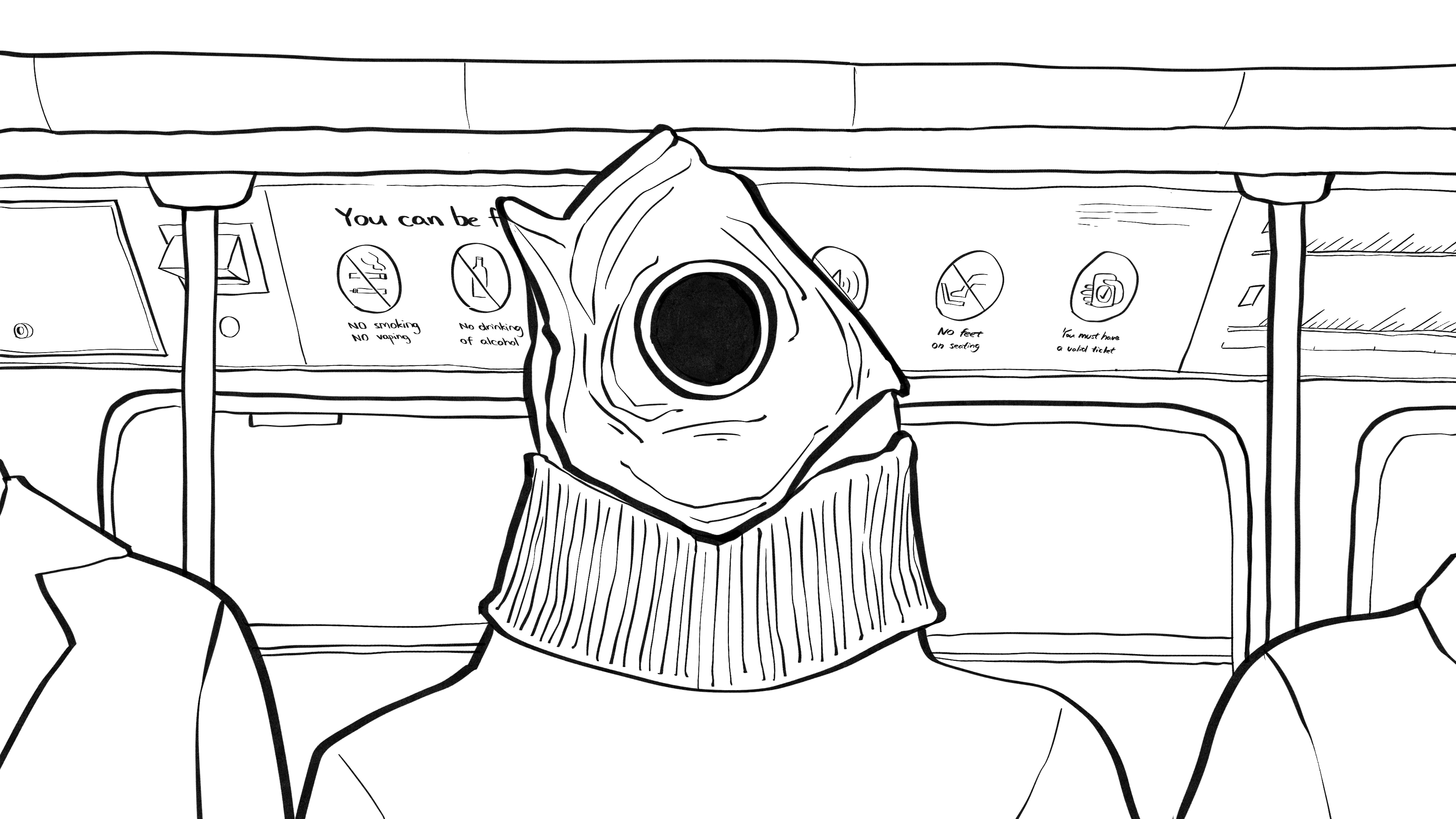
I also considered beginning with the protagonist. The audience would first see them standing on the tram, then discover the surrounding fish-headed passengers in the wide shot. The protagonist remains equally indifferent in both versions. They show no surprise and do not turn to discover anything unusual. The choice therefore mainly affects the audience: who do we see first, and when do we see the rest of the carriage?
To judge the difference between these openings, I compared them with the following two shorts. The classroom sequence begins with the protagonist writing before showing the fish-headed teacher. The final short begins with looking at a phone and washing a face, before the protagonist looks up at the fish-headed reflection. Beginning the tram sequence with the protagonist would give the last three shorts a similar rhythm: an ordinary activity followed by something unusual entering the image. I was concerned that the audience might become familiar with this order and start waiting for the fish head to appear.
The close-up gives the second short a different opening. The fish head is visible immediately. The wide shot then establishes its surroundings and the protagonist’s position within the crowd. Cutting from the toilet fish to the fish-headed passenger also maintains a direct visual connection between the two shorts. The unusual face is already in front of us, while the protagonist simply stands alongside the other passengers.
Comparing the four shorts also made me notice changes in the protagonist’s relationship with the crowd. At the beginning of the first short, we see other people’s backs at the party before finding the protagonist making their way through them. The camera follows them into the bathroom and gradually concentrates on them. The second short places them among people again. This time, the protagonist and the other passengers share the composition of the tram.
The classroom in the third short is also crowded, but its opening gives us a full view of only the protagonist. They sit in the centre, while the neighbouring students’ shoulders and the classroom sounds establish that they are not alone. More classmates become visible when the camera turns towards the teacher. What interests me here is that the protagonist is still among people, while the framing already presents them individually.
In the fourth short, the protagonist is finally alone. There is nobody else in the bathroom at home, and the fish head in the mirror is their own. I initially understood the four shorts as a movement from public to private space. However, the first short already enters a bathroom before the work returns to the tram and classroom. More precisely, the camera’s attention gradually gathers around the protagonist: finding them in a crowd, showing them alongside others, framing them individually in an occupied room, and finally remaining with them alone.
This revision began with the choice of an opening shot and helped me see the connections between the four shorts more clearly. The tram sequence needs time for the audience to observe the protagonist among the passengers. The close-up introduces the unusual face, leaving the wide shot for the protagonist and the people around them. Their lack of an obvious reaction gives the audience room to consider how closely they belong to this crowd, and how distant they seem within it.
AI acknowledgement: ChatGPT was used to help organise my reflections and refine the structure and English expression of this entry. The animation and final creative decisions are my own.