When we talk about the uncanniness created by this aesthetic, what are we actually talking about? And when we try to create this feeling ourselves, why do we so often find ourselves following similar paths?
“The uncanny is an uneasy audience response that occurs when something recognisable can no longer be interpreted with complete confidence.”
This was the first working definition I wrote in Assessment 1 two months ago. During this week’s WIP presentations, however, I began to reconsider it.
Across several different works, similar signs began to surface.
One VE project moved through a dark and empty playground, a corridor scattered with rubber ducks, and an office where a telephone continued to ring beside a figure whose head had turned backwards. In Fog Machine, heartbeat and breathing sounds were later played alongside abstract imagery. Other presentations introduced unsettling music and electronic sounds with a retro quality. After only a few of these elements appeared, the word uncanny surfaced almost automatically.
Recognition arrived before explanation.
Two months ago, I focused on the moment when something familiar begins to change. We first recognise a body, an object or a space, then discover that one of its relationships can no longer be trusted. Now, the uncanny seems to have undergone a similar transformation. Corridors, lighting, sounds and visual textures that were once used to produce unfamiliarity have become a familiar language through repeated viewing.
The development of the Backrooms demonstrates how this language formed. Day Cho and Natalie Underberg-Goode trace its transformation from an anonymous online image into an extensive story world. The original office-like space was repeatedly shared and remade across Reddit, TikTok, YouTube and video games. New rooms, sounds, creatures and rules gradually appeared through this process (Cho and Underberg-Goode, 2025).
Through this continuous expansion, an empty corridor has become a sign that can be recognised almost instantly. When we see fluorescent lights, old wallpaper and low-resolution imagery, we may already expect the space to repeat endlessly or imagine an unseen presence waiting beyond the next corner. Forms that once disrupted expectations have gradually established a new set of expectations.
The presentation of Fog Machine allowed me to experience this change directly. The abstract imagery was initially presented without sound, and its slow movement and repetition felt mesmerising. Once heartbeat and breathing sounds entered, the image immediately moved in another direction. I began searching for an invisible body and connected those sounds with the uncanny almost immediately.
The classroom discussion about duration became connected to this question. One response suggested that prolonged viewing could cause the image to lose its meaning. The teacher wanted it to continue for longer, allowing the audience to become fully immersed. When an atmosphere is already recognisable, duration can still make the act of watching compelling. The audience understands what kind of world they have entered, then begins to feel how long that world can be sustained and where their attention is allowed to move.
This made me think that we may repeatedly return to the uncanny because it now operates as a relatively stable cultural and aesthetic framework for organising otherwise vague emotions.
An image of a liminal space can quickly organise feelings of emptiness, nostalgia, loneliness and mild unease. The Backrooms, Dreamcore, Weirdcore and Liminal Space are not identical to the uncanny, but they often use overlapping conventions to produce uncertainty, nostalgia and unease. By giving these vague emotions searchable, collectable and shareable forms, they make them easier to recognise and return to.
In the classroom, I quickly recognised that these works were moving towards the uncanny. My attention then travelled further inside this recognisable form. Where was the breathing coming from? Why did nobody answer the ringing telephone? Who did the rubber ducks in the corridor once belong to? Was another unseen person still present in the dark playground?
The genre provides a direction into the work, while the work can preserve specific uncertainties within it.
This question returned while I was designing the sound for The Bar.
When the main character runs into the bathroom, his rapid breathing clearly belongs to his body. After he finishes vomiting, the breathing returns and continues into the shot of the fish. The audience may recognise this as uncanny sound design, while the ownership of the breathing becomes unstable through the transition between images. It may still come from the character outside the frame, while the shifting lines around the fish suggest another possible owner. For this reason, I would keep the source unresolved rather than clarify it through dialogue or a more literal sound cue.
This has helped me understand that a work can be recognisable at the level of genre while preserving uncertainty within its specific relationships. We may know that we are watching something uncanny without knowing what is happening in front of us.
Reading the sentence I wrote two months ago again, I now want to continue it:
The uncanny is an uneasy audience response that occurs when something recognisable can no longer be interpreted with complete confidence. When the uncanny itself becomes familiar, it becomes a language that we can return to repeatedly.
Familiarity does not end the fascination. Instead, it gives difficult emotions a stable form and gives creators and audiences a shared point of entry into the work.
Once the audience already knows that they are watching something uncanny, what remains that they still cannot immediately recognise?
This may be what I want to search for next.
WIP: Developing the Classroom Scene
This week, I have been working on the third short film in Stranded Fish, which takes place in a classroom.
This scene is about a difficulty in communication. The people around the protagonist turn and stare at them. The teacher appears to be speaking, but the protagonist cannot understand what is being said. The situation itself is familiar. I can recognise that someone is addressing me and expecting a response, but I cannot quite read their face or understand their words.
While developing the scene, I started thinking about whether the writing in the classroom could become part of this experience too. I decided to explore a banner above the blackboard, behind the teacher’s head.
The placement came from my own experience of attending school in China. I remember many classrooms having slogans above the blackboard. These would often encourage students to work harder, make progress or work towards a shared goal. For me, this is quite an ordinary classroom detail. It gives the banner a familiar place within the environment.
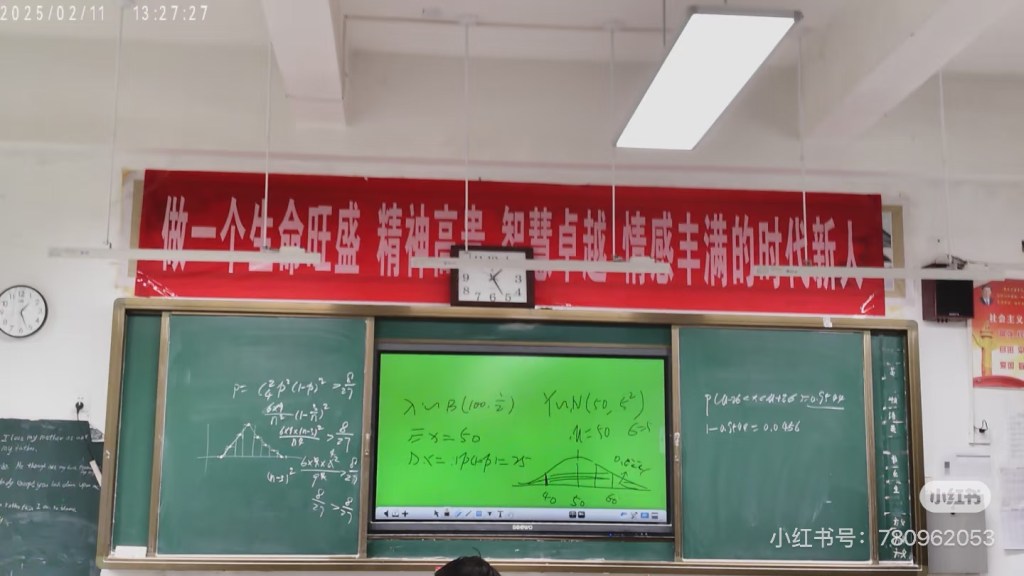
However, the sentence I chose does not have the usual meaning of a classroom slogan. It came from a dreamcore image I had previously encountered online.
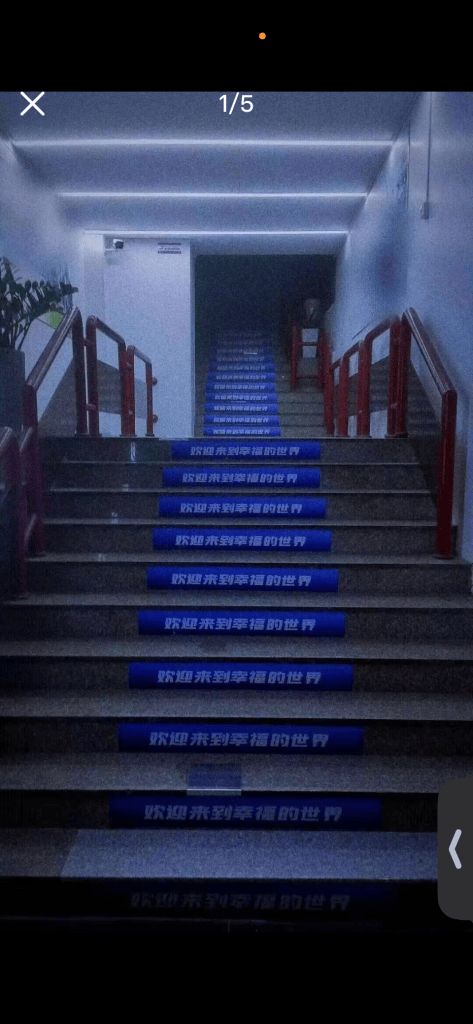
In this image, the words “欢迎来到幸福的世界” appear repeatedly on the steps of a staircase. The sentence means approximately “Welcome to a World of Happiness.”
What stayed with me was how ordinary the sentence seemed on its own. It sounds welcoming and reassuring. But the staircase leads towards a dark space that I cannot clearly see, and every step repeats the same promise. The image gives me very little reason to feel reassured, while the words continue to tell me that I am entering a happy world.
This connects with something I have been exploring through my uncanny research: familiar language can begin to feel strange when it appears in a situation where it does not quite belong. Repetition can make that mismatch more noticeable. The words remain perfectly understandable, but their relationship with the environment becomes difficult to settle.
I wanted to bring this into the classroom scene. Behind the teacher’s unreadable fish face, the room would still be welcoming the protagonist to a world of happiness.
During production, I also started thinking about how this detail might work differently for viewers who can read Chinese and those who cannot.
For viewers who do not read Chinese, the banner may look like a clear message without providing access to its meaning. This interests me because it connects directly with the teacher’s mouth movement. The teacher is looking towards the protagonist and opening and closing their mouth, but the words cannot be understood. Behind their head, something that appears to be writing is also communicating without becoming understandable.
I hope these two parts can support each other. The difficulty in communication would extend from the face and voice into the surrounding environment.
For viewers who can read Chinese, I wanted to explore another layer. They may recognise the meaning of the sentence and notice how strangely it sits within this interaction. But I also wanted the act of reading itself to become slightly uncertain.
I had previously been looking at Chữ Nôm, a historical writing system used in Vietnam. Some of its characters interested me because I could recognise familiar elements without necessarily being able to read the whole character. I would start trying to understand it, then realise that the structure was not quite what I expected.
This gave me a way to develop the banner further.
Rather than using actual Chữ Nôm, I developed fictional characters by retaining some parts of the original Chinese characters and changing others. I drew and adjusted these characters myself within the classroom image, exploring how much of each original character could remain recognisable while its structure became unfamiliar.
The sentence still has familiar spacing and recognisable parts. I hope a Chinese reader can attempt to reconstruct its meaning, while also noticing that the characters look wrong in ways that are difficult to immediately explain. This is the kind of experience I am thinking of as a “textual uncanny valley”: something comes close to a familiar form, but recognition does not happen smoothly.
These decisions came from thinking about the audience’s language and cultural background. Someone who does not read Chinese may encounter an inaccessible message. Someone who does may find the message partly accessible, while its meaning and letterforms create different kinds of uncertainty.
For me, both connect with the same experience at the centre of this scene:
Everything around me seems to be communicating, but I cannot quite understand it.
At this stage, this is still a work-in-progress experiment. Because I already know the original sentence, I can read more into the altered characters than a new viewer might. I want to see how much Chinese readers can actually recognise during playback, whether other viewers notice the banner, and how it works alongside the teacher’s face and mouth movement.