“I heard a voice that spontaneously said ‘Look behind you’. And I did. […] When I looked behind me, I saw the void.” — Marc Leavitt, Buddha at the Gas Pump interview (2022)
But does seeing more necessarily mean seeing the truth?
A few weeks ago, I came across this episode in the Chinese edition of Marc Leavitt’s Enlightenment: Behind the Scenes. In a journal entry, Leavitt describes playing George Harrison’s My Sweet Lord when he heard a voice telling him to look behind. He turned around, saw what he described as “the void,” and understood it as a revelation of reality. What had previously remained outside his awareness now appeared behind him, while the living room in front seemed more like an image on a screen. The quotation above comes from his own later retelling of the same experience in English.
The passage fascinated me, but it also made me question the authority given to this new view. Who, or what, was the voice asking him to turn around? It could be understood as intuition, the unconscious, a spiritual presence or the way the experience was later organised into a story. Turning around allowed him to see something that had previously been unavailable. However, why should a wider view become the final one?
I think this question stayed with me because the desire to find a complete perspective is familiar to me. I often try to step outside my own position and consider every possible point of view. I used to believe that if I gathered enough information and understood every side, I might avoid making mistakes and reach a judgment that was completely objective, fair and correct. This habit can make me question my first response, but it can also make me distrust my own experience, as though fairness can only be achieved by removing myself from the situation.
The more I thought about Leavitt’s account, the less certain I became that a wider field of vision and a more complete truth were the same thing. A 360-degree panorama may appear spatially complete, but it is still organised through human vision. It does not contain everything that could be heard, touched or remembered, what another organism might sense, what another person is thinking, or what happened before that moment. Looking behind can reveal a previous limit without removing limitation itself.
This also made me question the metaphor of perspectives as fragments of one finished picture. The metaphor suggests that a complete image already exists somewhere behind them and that, if enough pieces are collected, it can eventually be reconstructed. Yet somebody must still decide how the pieces are selected, translated and arranged. The finished result may include more information, but it remains an image constructed through another frame.
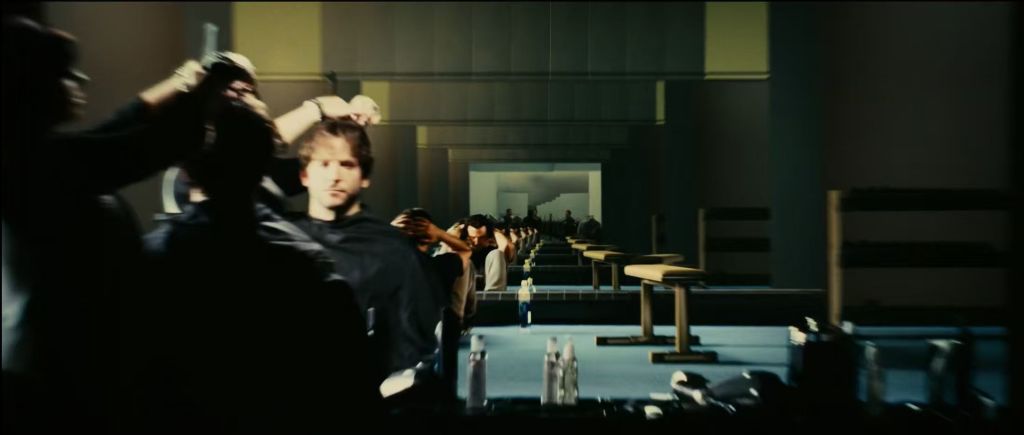
Film still from Limitless, directed by Neil Burger (2011).
I am not arguing that no complete reality exists. I do not know whether it does. What I question is whether I can—or should—construct an image that claims to contain it. Even if a final reality exists independently of me, a work that I make cannot simply stand outside every body, history and form of perception.
The distinction is already present in Leavitt’s account. Before he turned around, the 180 degrees in front of him did not appear as a visibly broken half. It functioned as the whole of what was available to his awareness at that moment. Only after he turned could the earlier view be described as incomplete. The boundary of his world had changed, but this did not prove that every possible boundary had disappeared. A limited view may therefore contain a whole experience without becoming the whole truth.
The concept of Umwelt, introduced in class this week, gave me a clearer way to understand this. Jakob von Uexküll uses the term to describe the meaningful perceptual world available to an organism through its sensory and bodily capacities. In his well-known example, the world of a tick is organised through a small number of signals that matter to its life. Many things that are visible and important to a human have no place in that world at all (von Uexküll, 2010).
The tick does not experience all those unavailable colours, objects and details as empty spaces that need to be filled. Its Umwelt is the world through which it perceives and acts. To a human observer, this world may look extremely limited. From within the animal’s life, however, it is not simply a broken piece waiting for a larger perspective to complete it.
Different Umwelten may therefore be more than separate camera angles directed at the same finished scene. They are organised through different bodies, forms of attention and possibilities for action. Placing several of them beside one another can reveal differences and connections, but there is no guarantee that they will join into one neutral image. The act of joining them would itself introduce another frame.
Donna Haraway’s idea of situated knowledge helped me understand why recognising these limits does not require abandoning objectivity. Haraway criticises the fantasy of a view that appears able to see everything while hiding where it looks from. She argues instead for embodied and accountable knowledge that acknowledges its partial location (Haraway, 1988). A camera may be placed outside a character, but someone still chose where to put it, and it shows only what its frame permits. The problem is not that a view is situated. The problem begins when it conceals this and speaks as though it were the world itself.
Throughout this semester, I have kept returning to the title of the course, and Umwelt has added another layer to how I understand it. In Heightened Multisensory Experience, heightened does not necessarily mean making every sensation louder, brighter or more dramatic. It may mean bringing a relationship within perception into greater awareness. Multisensory can also describe the tension between sensory layers: an ordinary sound may accompany an impossible image, or a calm rhythm may make a visual disturbance feel more unsettling.
Most importantly, experience is not an object that can be transferred intact from the creator’s mind to the audience. As a creator, I can decide what remains inside or outside the frame, when a sound appears and how long an image lasts. I can organise the conditions of an encounter, but each audience member brings their own body, memories, expectations and attention into it.
In Week 6, I asked how representation could serve an experience rather than replace it. Umwelt does not completely resolve that question, but it offers a partial answer. Representation may not need to reproduce an experience in full. It can instead provide a point of entry from which another person, situated in a different perceptual world, forms an experience of their own.
This does not make communication impossible. Different perceptual worlds are not necessarily sealed off from one another. A creative work can establish some common ground without requiring everyone to feel or interpret it in exactly the same way. The task is not to reproduce my entire private experience for somebody else, but to find forms through which another person may approach it through their own experience.
At the same time, I cannot assume that a work which appears open to me will also feel open to its audience. Refusing to state a conclusion does not make a work neutral. Framing, sequence, duration and emphasis continue to guide attention. Umberto Eco’s concept of the open work is useful here because openness does not mean an absence of structure. A work may invite several interpretations while still organising the field in which they occur (Eco, 1989). If its structure quietly presents one position as a final revelation, an attempt to avoid one answer may become another kind of answer.
My current animation, Stranded Fish, has become one small way for me to test these questions. In an earlier animation study, I shifted between third-person and first-person views to create a difference between audience and character awareness. An overhead view established spatial trust; later, changes such as slippers appearing in a different position allowed the audience to recognise that something was wrong before the character did. The third-person shot functioned as a relatively reliable point of comparison.
In Stranded Fish, I use a similar change of viewpoint but no longer want the third-person view to reveal what the world objectively is. The final mirror scene makes this especially uncertain. The audience appears to see the protagonist from outside, but the fish head in the reflection is still encountered through the protagonist’s own vision. It does not confirm whether the body has physically changed or whether the change belongs to perception. I am not hiding a correct version of the world for the audience to solve; I am choosing not to introduce a final viewpoint that resolves the difference.
The fish itself provides a possible sensory point of entry. Viewers may respond differently to its unblinking eye, opening mouth, scales, slippery surface or struggling tail. They do not need to share one complete image or interpretation of a fish. These partly shared bodily and cultural associations can nevertheless act as a common sensory anchor, allowing different viewers to approach the work through their own experiences.
This is a choice for this project, not a rule that I think every creative work should follow. Other contexts may require a stronger commitment to evidence, background and multiple accounts. Even then, comprehensiveness should not be confused with a view from nowhere. For this work, I am less interested in constructing a complete image than in remaining honest about the limits of the one I construct.
The question I want to continue carrying into my practice is:
If I cannot construct a complete image without turning my own position into an authority, how can I remain truthful to a partial experience while still creating enough common ground for others to enter it?
References
Eco, U 1989, The Open Work, trans. A Cancogni, Harvard University Press, Cambridge, MA. Originally published 1962.
Haraway, D 1988, ‘Situated Knowledges: The Science Question in Feminism and the Privilege of Partial Perspective’, Feminist Studies, vol. 14, no. 3, pp. 575–599, doi:10.2307/3178066.
Leavitt, M 2012, Enlightenment: Behind the Scenes, Reality Publishers; Buddha at the Gas Pump 2022, ‘639. Marc Leavitt’, interview recorded 20 March, viewed 14 September 2026, https://batgap.com/marc-leavitt/.
von Uexküll, J 2010, A Foray into the Worlds of Animals and Humans: With A Theory of Meaning, trans. JD O’Neil, University of Minnesota Press, Minneapolis.
AI acknowledgement
ChatGPT was used to help organise my notes and draft, and refine the clarity of the English writing.