A faint sense of the uncanny
Have you ever opened your mouth to speak while surrounded by people, yet felt a strange distance between yourself and everyone else?
Nothing around me needs to stop for this feeling to appear. Traffic keeps moving, people pass by and conversations carry on. I may still appear to be participating like everyone else, yet speaking can feel strangely detached from being heard. I can feel the same distance when no one is speaking at all, or even when another person is speaking directly to me. To me, this is a faint form of the uncanny—so slight that I may only recognise it after I have stepped away from the group.
During Now or Never, that feeling began to take shape through faces, voices and, eventually, fish.
Faces and voices in a crowd
The first work I stopped at was outside Melbourne Town Hall. Two adjacent screens showed a face singing a familiar song. Another face appeared, and then more joined it. As the chorus grew, the voices drifted in and out of time. I could see every mouth forming words, but it became increasingly difficult to separate one voice from another.
The work was Haejung Jung’s Row, Row, Row Your Boat. Jung used 3D scans of faces collected in Australia and Korea to create a shifting chorus in which identities multiply and boundaries blur (Now or Never Melbourne, 2026a).
I felt pressure building as more voices joined. It reminded me of social situations in which I continue participating even though I cannot make myself heard, and only understand my discomfort after leaving. At that point I had not yet worked out the fish motif, but the image of many visible mouths and no distinguishable voice stayed with me.
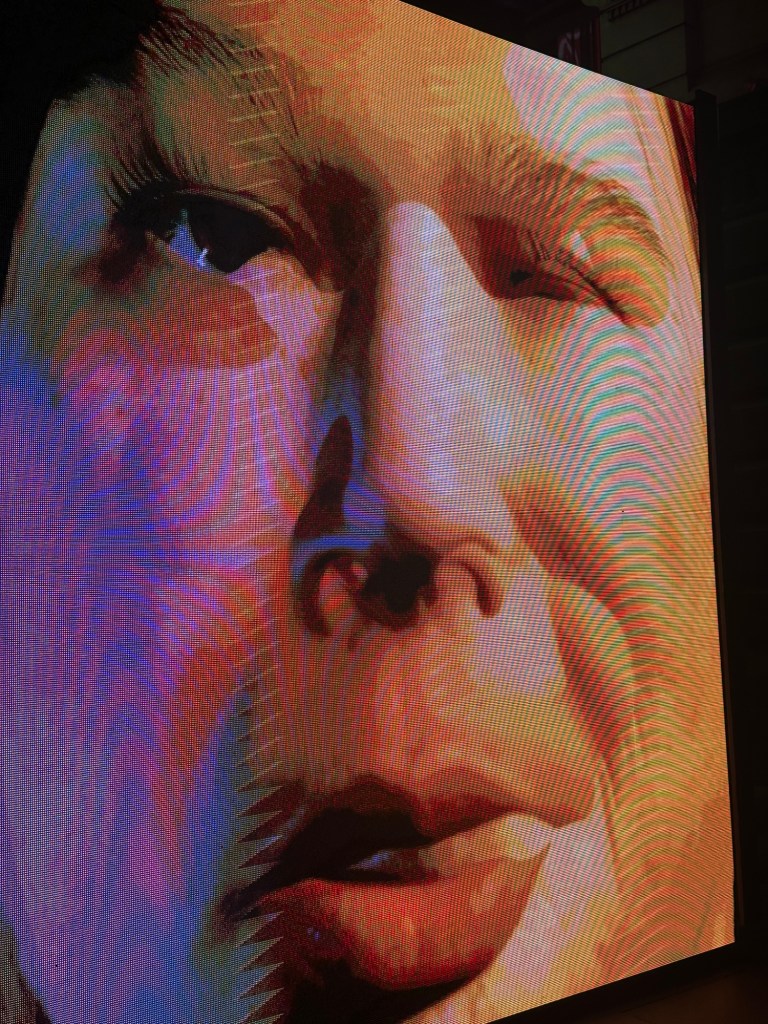
Figure 1. Detail of Haejung Jung, Row, Row, Row Your Boat, presented outside Melbourne Town Hall during Now or Never 2026. Photograph by the author.
Fish across the city
Later, at Flinders Street Station, I saw fish moving across the exterior of the building. I first noticed the projection’s saturated, almost hallucinatory colour.
The projection was ENOKi’s From the Dhungala to the Birrarung: Water is Life, a work grounded in the aquatic life of the Dhungala and the Birrarung and in First Peoples’ relationships with those waterways (Now or Never Melbourne, 2026b).
Jung’s chorus was still in my mind when I reached the station. The projected fish moved as though the façade had become water, while the solid wall beneath the light remained visible. They seemed to be swimming, but the surface supporting them could not hold water. I began to think of them as stranded.
Below the projection, commuters and pedestrians continued moving through the station. For a moment, the fish above and the crowd below seemed to echo one another. A private feeling I sometimes carry among other people had appeared across one of Melbourne’s most recognisable public landmarks. I began to imagine everyone moving through the station, including myself, as stranded fish.
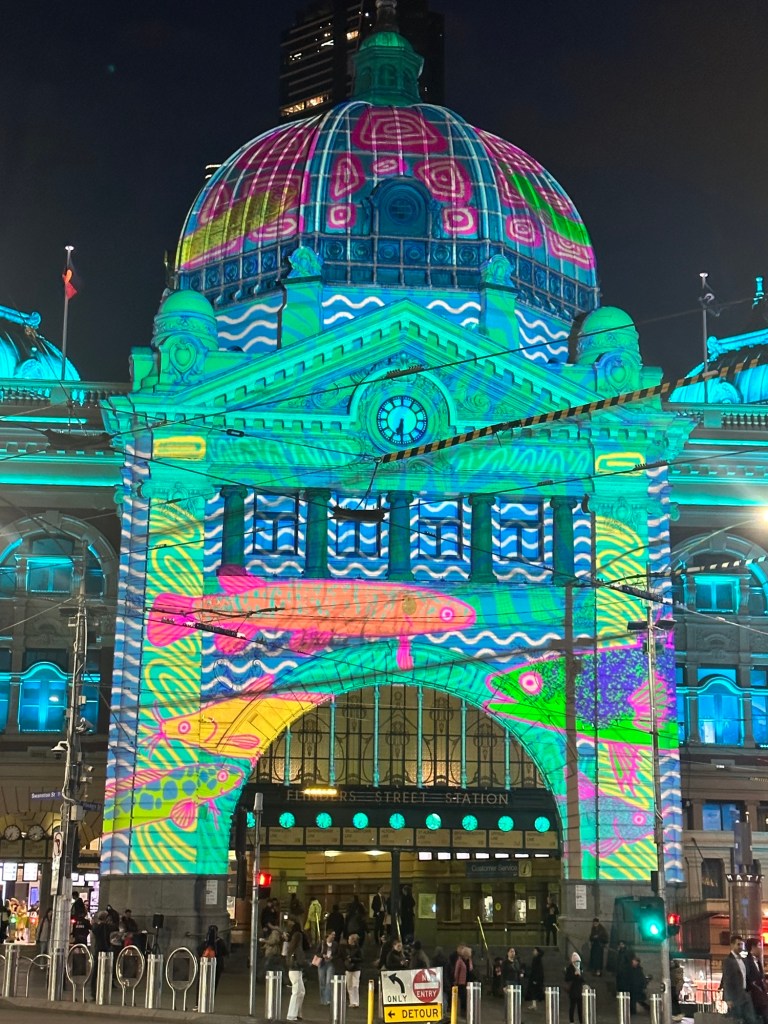
Figure 2. ENOKi (Dja Dja Wurrung and Yorta Yorta), From the Dhungala to the Birrarung: Water is Life, projected onto Flinders Street Station during Now or Never 2026. Photograph by the author.
Later that night, as I walked beside the Birrarung, I imagined the fish leaving the façade and swimming through the air around me, keeping pace as I walked. This brought back a dream from earlier this year.
In the dream, I had forgotten to change the water in a fish tank. The water had become cloudy, and the fish could no longer breathe properly. It pushed half of its body out of the tank. Its mouth kept opening and closing, and its eye remained fixed on me. The image stayed with me for several days after I woke up.
On the station wall, the fish moved across stone as though light had supplied the water. In the dream, the fish was surrounded by actual water, yet that water could no longer sustain it. Its opening and closing mouth brought Jung’s chorus back into the image. Speech and breath began to share the same movement.
From an event to a recurring image
Looking back, the evening at Now or Never also changed what I paid attention to in animation. I had usually begun with a sequence of events and asked what should happen to the character next. Moving through works based on projection, light and sound showed me how an image or sensation could gather meaning without a complicated plot.
The festival experience as a whole shifted my process. I began asking what might happen each time the same image returned, allowing a recurring motif and sensory accumulation to guide the animation.
Developing Stranded Fish
These thoughts became Stranded Fish, a short experimental animation following the same protagonist through four linked vignettes: a high-intensity social gathering and bathroom, a crowded tram, a classroom, and a bathroom mirror. The vignettes will play as one continuous sequence, connected by recurring images, transitions and sound, although the causal relationship between them will remain uncertain.
Across the sequence, I want to stay with the feeling of being alone while surrounded by bodies, movement and voices.
In the first vignette, the protagonist leaves the gathering and vomits a living fish into a toilet. A close view of the fish becomes a commuter’s fish head through a match cut. The next vignette places the protagonist in a crowded tram carriage, surrounded by fish-headed passengers. In the classroom vignette, a fish-headed teacher addresses the protagonist directly in a one-to-one exchange while the rest of the class watches. The teacher’s mouth opens and closes, but the protagonist cannot understand the words. A separate final vignette takes place in a bathroom: the protagonist faces a mirror, and their reflection has a fish head.
I plan to develop the work primarily as a 2D hand-drawn animation. The current storyboard contains 14 shots and has an estimated duration of approximately 47.5 seconds. Its drawing style already establishes a direction close to the finished work I imagine. During the mid-semester break, I will refine the line quality and degree of stylisation, and test whether colour belongs in the animation and how much of it is needed.
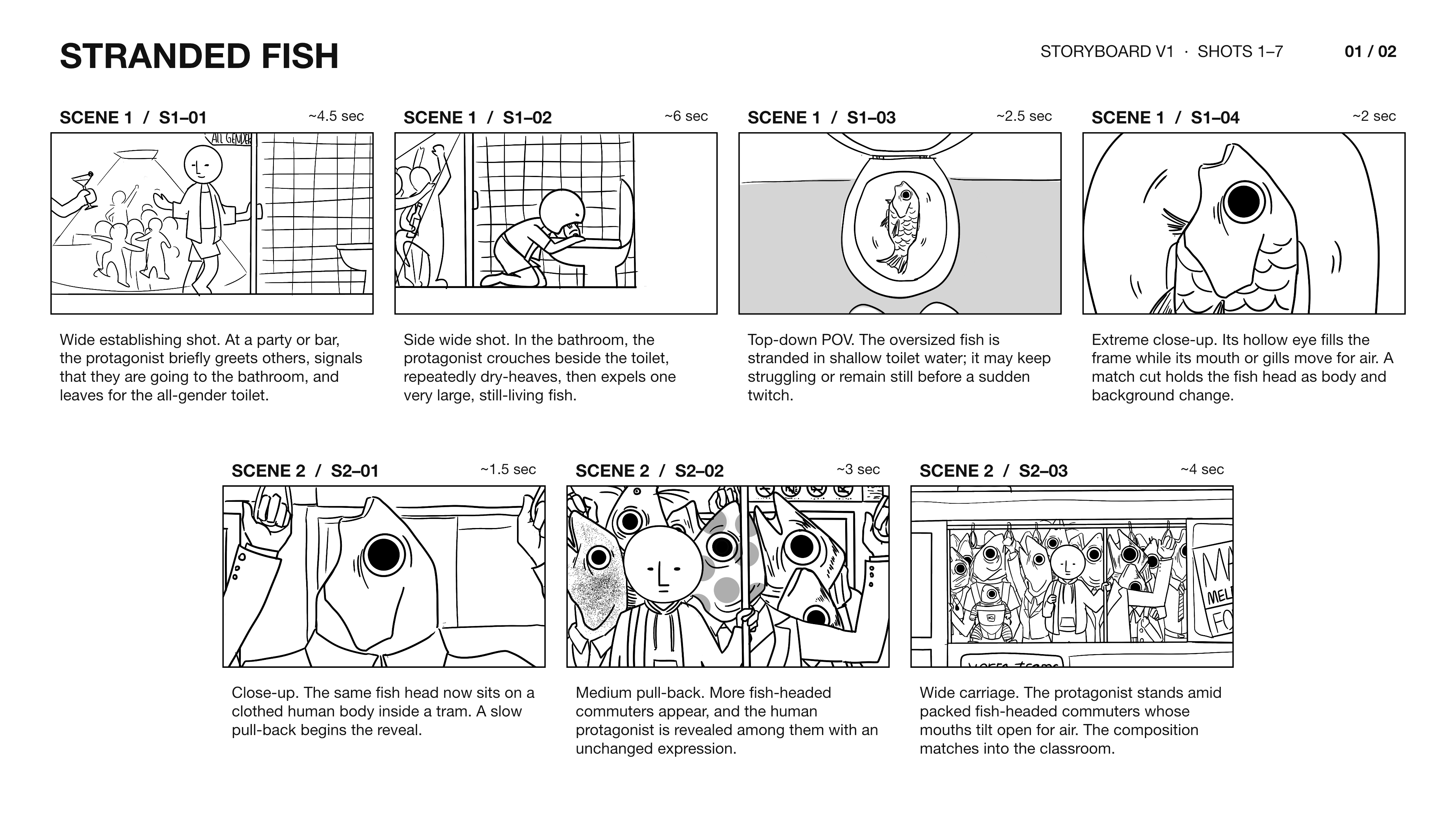
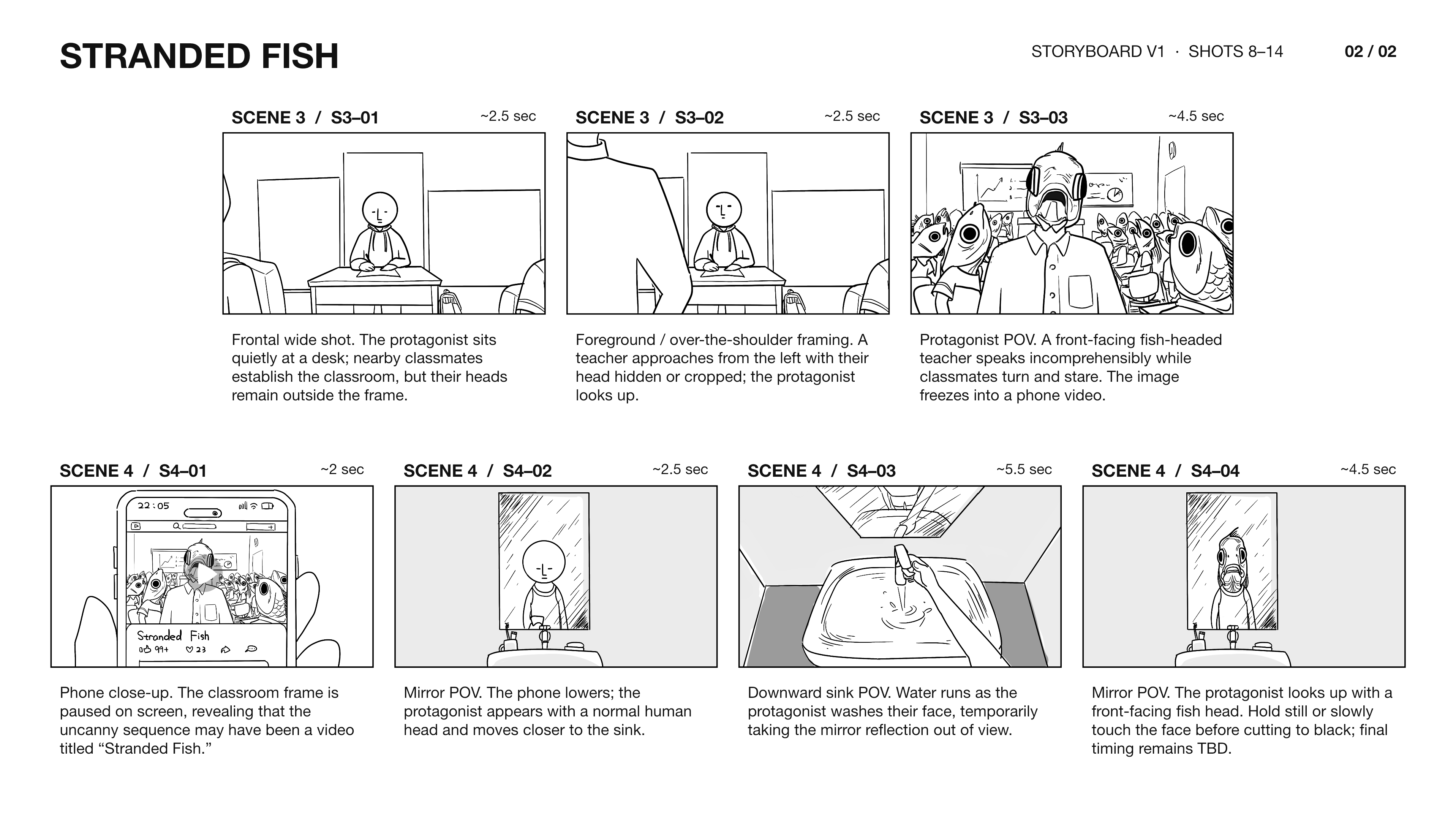
Figure 3. Storyboard V1 showing the complete four-vignette structure and the current visual direction. Line treatment, stylisation and the use of colour will be refined through further visual tests.
Why fish?
The dream clarified why a fish could carry the project. A fish depends visibly on its surroundings. In water that can sustain it, its body can appear fluid and effortless. When the environment fails, the same body can appear heavy, rigid or distressed. The dream showed me that a fish can even be surrounded by water and still be stranded inside it.
The title gave me a way to explore how someone might feel stranded while physically surrounded by people, voices and familiar routines. Those surroundings may continue to function while the person within them feels unsupported or disconnected. The fish turns this subtle relationship between a body and its environment into something that can be seen.
My aim is for viewers with very different feelings about fish—including people who fear them, feel neutral towards them or even like them—to experience the animation as uncanny. I want this unease to reach viewers through sensory memory. Even someone who likes fish may remember or imagine its cold, wet and slippery surface, a faint stickiness and a fishy smell. When the fish enters a toilet, replaces a human head and multiplies through a crowded tram, those half-remembered sensations enter places where they do not usually belong.
The fish’s face and movement carry another instability. Its unblinking eye can look intensely focused while remaining difficult to read. A stranded fish can lie rigid and almost corpse-like, then reveal life through a small movement of its mouth, gills or tail. The same repeated movement can suggest breathing, distress or attempted speech. A fish can look beautiful, ordinary, comic or disturbing, sometimes within the same image. This allows an ordinary-looking fish to hover between an inert object and a perceiving presence.
Takahashi et al. (2015) found wide variation when participants rated the eeriness of 180 recognisable fish photographs, both across the images and between viewers. Photographs rated as more uncanny delayed some speeded responses, while the delay did not appear to be mediated by threat. The study did not compare participants according to whether they feared, liked or felt neutral towards fish, so it cannot establish whether my aim will succeed. For this project, pre-existing fear and the uncanniness produced by a particular image become two separate questions to test.
Gonçalves and Biro’s (2018) term “animacy detection malfunction” gives me a way to frame the uncertainty between life and death. It describes conflicting responses to a body carrying signs of both an animate agent and an inert object. Their research concerns how animals respond to death and cannot predict how an animation audience will react. I use it here as a visual question: how long can the toilet fish appear object-like before one small movement returns it to the viewer as a living presence?
I will keep the fish recognisably ordinary and test how framing, scale, repetition, sound and small movements alter the experience. One animatic test will compare continuous struggling with an almost-motionless landing followed by a delayed movement of the mouth or gills. A small viewer test will ask people with different reactions to fish whether the scene feels uncanny and which moment creates that feeling.
The scene of vomiting a living fish existed before I returned to Kristeva’s writing on abjection and unstable boundaries between subject and object, inside and outside (Kristeva, 1982). Her writing helped me recognise a relationship already active in the image: something leaves the protagonist’s body and immediately becomes an independent life that can look back at them. Expulsion fails to produce a clean separation.
The fish motif also suits the structure of the whole animation. The same image can appear as an animal expelled from the body, multiply across a crowd, replace another person’s face and finally return as the protagonist’s own face. It can move between body, environment, other people and self, changing its role each time it appears.
How the fish changes across the sequence
For the viewer, the first fish arrives as an isolated and impossible event. Its return on the tram creates recognition without supplying an explanation. Each later appearance changes who is looking at whom and brings the fish closer to the protagonist.
The toilet fish remains alive, preserving its breath, movement and gaze. It is too large for the bowl and cannot swim normally in the shallow water. I carried the direct gaze from my dream into this scene. When the fish looks back, it becomes a perceiving presence as well as something that has left the protagonist’s body. The match cut then carries its shape and position into the first commuter’s head, making a private event return and multiply in a social environment.
Most tram passengers are drawn from the side with their mouths angled upward, formally echoing stranded fish trying to breathe. They continue their ordinary commute, leaving the meaning of that repeated posture unsettled. In the classroom, I am testing what happens when the face itself becomes difficult to read. A fish head still has eyes and a moving mouth, but the protagonist can no longer rely on familiar human expressions to understand attention, emotion or speech. The face remains active and perceiving: it approaches, addresses and looks back at the protagonist.
The final mirror makes the division between the human protagonist and the fish-headed group unstable. The image can be approached as a transformation, a recognition, or something between the two. In each case, the protagonist can no longer remain safely outside what they have been observing.
Sound will follow a related movement. Recognisable gathering voices can overlap and drift out of sync, continue into the tram, and narrow in the classroom to the rhythm of speech with no intelligible words. Breathing and mouth movement placed inside otherwise ordinary environmental sound will allow the unease to accumulate gradually.
Carrying the earlier proposal forward
This project grows from a question I was already exploring: what happens to a person’s sense of self when a familiar environment begins to cross into their body and identity? In my earlier proposal, that environment was primarily domestic. A series of uncanny incidents gradually made the home unreliable, with each disturbance moving closer to the protagonist.
That concept has remained important to me. The difficulty was formal: each incident used a different image and required its own explanation and transition, so the project was becoming fragmented. The fish gave the existing question one visual form that could travel through the entire animation and change its role without requiring a new incident each time.
In Stranded Fish, the movement forms a loop: the fish appears to leave the protagonist’s body, returns through other people and the surrounding environment, and eventually appears as the self. The gathering, tram and classroom also expand the earlier domestic environment to include peers, strangers and authority. Other people’s bodies, voices, gazes and expectations become part of an environment that each person also helps to create.
This continues the conclusion I reached in Assessment 1: the uncanny can emerge inside a partially familiar world when enough information remains recognisable, while one relationship becomes difficult to trust. The bathroom, tram, classroom and mirror still function as everyday settings. The disruption enters the relationships between body and surroundings, face and communication, reflection and self.
Bringing the proposal into production
The next stage is to convert the storyboard into an animatic and test the current 47.5-second structure as one viewing experience. The research now needs to become visible in timing, movement, sound and design.
During the mid-semester break, I plan to:
- build and revise the animatic, including the current timing estimate;
- compare an almost motionless toilet fish with one that struggles continuously, and test the timing of its first mouth or gill movement;
- run a small viewer test with people who report different reactions to fish, focusing on whether the scene feels uncanny and when that feeling begins;
- test the toilet-fish-to-tram match cut and the transitions into the classroom and mirror;
- develop side-facing and front-facing fish heads that belong to the same visual system while supporting different relationships of breath and gaze;
- refine the 2D line quality, degree of stylisation and use of colour;
- test layered and drifting voices, breathing, unclear speech and ordinary environmental sound.
Current reflection
The project now has a clearer emotional centre: the loneliness that can remain in the middle of movement, conversation and a crowd. As the fish changes its position and relationship to the protagonist, its meaning can remain unsettled for the viewer.
Stranded Fish began within this course and has become a way of bringing together parts of my own thinking: daily sensations, memories, discomforts and questions that I had not yet found a form for. The characters may struggle to make themselves understood, while making the animation is my attempt to make a difficult feeling shareable through image, sound and rhythm. The work comes from a private place, and I hope it can move beyond me once it is finished. A viewer may recognise something from their own experience or find a meaning in the fish that I had never anticipated. For me, that encounter is also part of completing the work.
References
Gonçalves, A. and Biro, D. (2018) ‘Comparative thanatology, an integrative approach: exploring sensory/cognitive aspects of death recognition in vertebrates and invertebrates’, Philosophical Transactions of the Royal Society B: Biological Sciences, 373(1754), 20170263. https://doi.org/10.1098/rstb.2017.0263
Kristeva, J. (1982) Powers of Horror: An Essay on Abjection. Translated by L.S. Roudiez. New York: Columbia University Press.
Now or Never Melbourne (2026a) ‘Row, Row, Row Your Boat / 「노 저어라, 노 저어라, 노 저어라 네 배를」‘, viewed 31 August 2026, https://nowornever.melbourne.vic.gov.au/event/row-your-boat
Now or Never Melbourne (2026b) ‘From the Dhungala to the Birrarung: Water is Life‘, viewed 31 August 2026, https://nowornever.melbourne.vic.gov.au/event/enoki
Takahashi, K., Fukuda, H., Samejima, K., Watanabe, K. and Ueda, K. (2015) ‘Impact of stimulus uncanniness on speeded response’, Frontiers in Psychology, 6, 662. https://doi.org/10.3389/fpsyg.2015.00662
Generative AI acknowledgement
I developed the project concept, four-scene structure and storyboard independently before using ChatGPT or Codex. I then described my existing storyboard, visual ideas and creative questions to these tools through spoken notes. They helped me organise this material into a clearer journal structure, put some abstract ideas into more concrete language, research and verify relevant sources when I asked questions, and refine the clarity of my English. They did not generate or decide the storyboard, plot or visual concept used in this project. The personal experiences, dream, drawings and final creative decisions are my own. I reviewed and revised all AI-assisted writing before including it in this journal.