Weekly Overview
This week, we listened to everyone’s Presentation 1. Many students chose the keyword “uncanny,” which did not surprise me because the word can generate many associations and approaches. What stayed with me was not one particular example, but how differently the same keyword could be interpreted through bodies, spaces, sound, movement and technology. Listening to the presentations expanded my understanding of what the uncanny might include.
Feedback on my presentation also prompted me to consider how the four strategies might relate to my own project. I had mainly used them to analyse existing works, so I do not yet have a clear answer. For now, I see this as an open question to revisit as my project develops.
We then listened to a guest lecture by Ian Haig. His practice offered another perspective on the uncanny, particularly through his treatment of bodies, technology and audiovisual intensity.
Reflecting on Ian Haig’s Practice
Ian Haig’s lecture gave me a broader perspective on experimental practice. His work relates to the uncanny, but it also explores bodies, technology, AI, media and sound. My previous understanding of the uncanny focused mainly on subtle moments when something familiar feels slightly wrong. Haig often uses a more direct approach. In the lecture, he described his practice through experimental and anti-narrative video, audiovisual experience, and a sense of perversity or “fucked-up-ness.”
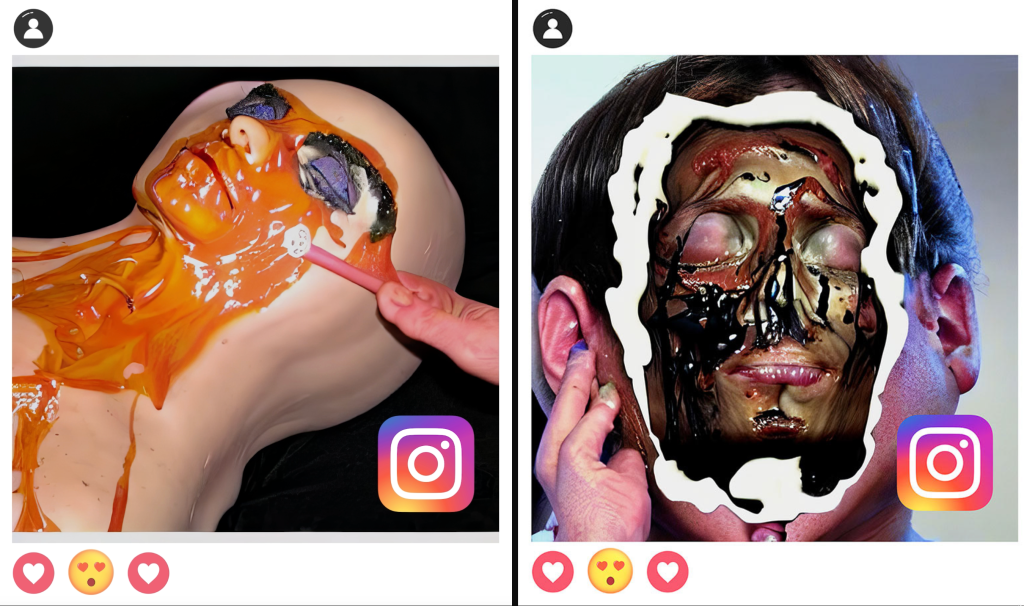
Instagram Auto Surgery (2024) is a particularly effective example of this direct approach. The work turns idealised Instagram bodies into images of cosmetic surgery, revealing what is normally hidden behind edited selfies. In everyday life, cosmetic modification can already produce a subtle uncanny feeling. A face or body remains recognisably human, but something may feel altered or difficult to identify. We can sense this unease without being able to explain exactly where it comes from.
Haig takes this uncertain response and amplifies it. By showing the surgical processes behind the finished image, he makes a hidden source of discomfort visible. Its medical imagery is clearly intended to grab attention, but I think the impact is effective because it supports the subject. A quieter approach might also communicate the same theme, and it would be interesting to consider how that could work. However, in this case, Haig’s directness reveals the physical reality behind online beauty standards in a way that a more subtle image might not achieve.
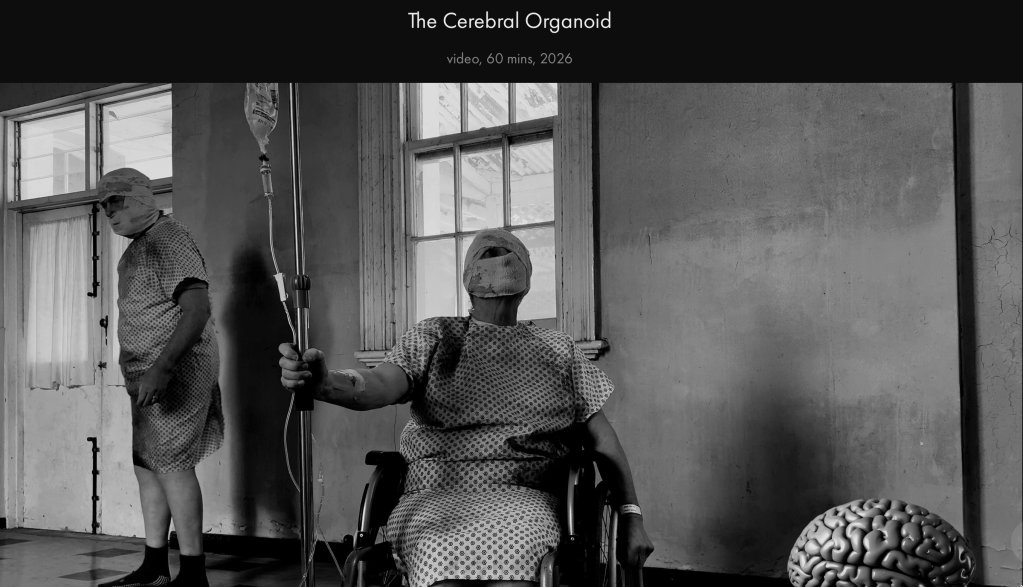
The Cerebral Organoid (2026) made me consider another side of his practice. The term “brain rot” normally describes a perceived decline in attention or thinking caused by excessive exposure to online content. Haig turns this metaphor into a fictional medical condition caused by AI. A research institute then attempts to treat its patients through further AI systems, brain implants and bodily correction. The contradiction is that the same technology associated with the problem is also presented as its solution.
Compared with some of Haig’s earlier works, the black-and-white imagery in the trailer initially appeared less confronting to me. Instead of relying mainly on exposed flesh or saturated medical imagery, it uses abandoned institutional spaces, a clinical atmosphere and artificial sound. The discomfort seems to shift from direct bodily shock towards a broader sense of social and technological breakdown. I am interested in whether this suggests a change in Haig’s visual approach, or whether he selected a different level of intensity because it was more suitable for this subject. I cannot yet determine the answer, but the comparison shows that his ideas do not always require the same visual method.
Before this lecture, I had limited experience with experimental film and experimental animation. Haig’s approach therefore felt different from much of my previous practice. He explained that he is less interested in plot and character development than in creating an aesthetic and audiovisual experience. Referring to Philip Brophy, he described cinema as “100% image and 100% sound.” I understood this to mean that image and sound do not simply support a story; they can become the main way in which a work produces meaning.
In my previous work, I usually treated audiovisual language as a supporting element within a narrative. Sound, colour, movement and composition could influence the audience’s emotions, sometimes at a subconscious level, but the story remained the main structure. Haig’s practice suggests another possibility: an audience may understand a work through rhythm, texture, duration, image and sound without depending on a detailed plot or background. I do not necessarily see my previous approach as a weakness. Instead, this course gives me an opportunity to explore another direction and extend the methods I already use. I am not yet sure how to make audiovisual language the main structure of a work, but I would like to study more experimental practices and test this through smaller exercises.
Not all of Haig’s works depend on exposed bodies. Worm Pornography uses the idea of a media parasite travelling through different platforms, connecting biological infection with the spread of information. Tripadvisor creates uncertainty through the gap between online reviews and physical reality. These works remain disturbing, but they rely more on absurdity, media language and uncertainty than bodily exposure. This shows that Haig can move between direct and indirect methods while continuing to explore related concerns.
His discussion of AI also connected with my previous journal entry about similar AI-generated faces. I had mainly understood this similarity as a limitation: different images begin to share the same smooth surfaces, proportions and expressions, reducing individuality and producing a subtle uncanny effect. Haig introduced another way of thinking about this problem. Instead of correcting unstable or distorted results, an artist can select, exaggerate and remix them as creative material.
This shifts the question from whether an AI image is accurate to what its errors can communicate. In Haig’s work, distorted bodies and unclassifiable forms support his themes of mutation, technology and unstable human identity. However, strange AI imagery does not automatically become a personal style. Repeated images of melted faces or incorrect bodies could also become another generic aesthetic. The artist’s decisions—why a particular error is retained and how it is combined with editing, sound and context—are what give it meaning.
Overall, I think Haig’s visual intensity usually supports his concepts and gives his practice a recognisable identity. However, this consistency also carries a risk. If audiences become too familiar with the style, they may anticipate the shock before considering what an individual work is trying to communicate. The artist’s identity could become more memorable than the specific concept of each work.
This is something I need to consider in my own practice. I do not want to become too attached to only one level of expression, whether that means always using strong visual impact or always relying on subtle uncanniness. Either method could become predictable through repetition. Rather than forcing every idea into one visual style, I need to consider what level of intensity is appropriate for each subject. A personal style may still emerge, but it should remain flexible enough to support the meaning of each work.
Reconsidering Curiosity Beyond Narrative
In my Week 2 journal, I discussed curiosity mainly through narrative. I thought that withholding information could make the audience curious about what would happen next. Darrin’s feedback made me reconsider this approach:
“I’d caution you against using narrative to drive curiosity—given that the premise of the studio is to focus on feelings rather than stories.”
His comment made me realise that I may have relied too heavily on narrative to explain curiosity. Narrative can create questions and anticipation, but this may be different from the sensory experience of curiosity that the studio asks us to explore. Rather than rejecting narrative completely, I want to temporarily set it aside and examine how curiosity can emerge through interaction, space, sound, movement and visual information.
Interactive works may offer a more direct way for audiences to experience this kind of curiosity. In a game or interactive installation, the audience can approach, touch or test something and receive an immediate response. Curiosity develops through a cycle of action, feedback and further exploration.
However, this does not mean that animation can only create curiosity through storytelling. Mainstream animated films often rely on narrative, and completely non-narrative examples may be less familiar to general audiences. Instead of removing the story entirely, I can examine how a particular animated sequence encourages curiosity through sensory and visual design. This includes sound, colour, lighting, composition, movement, pacing and the gradual control of information.
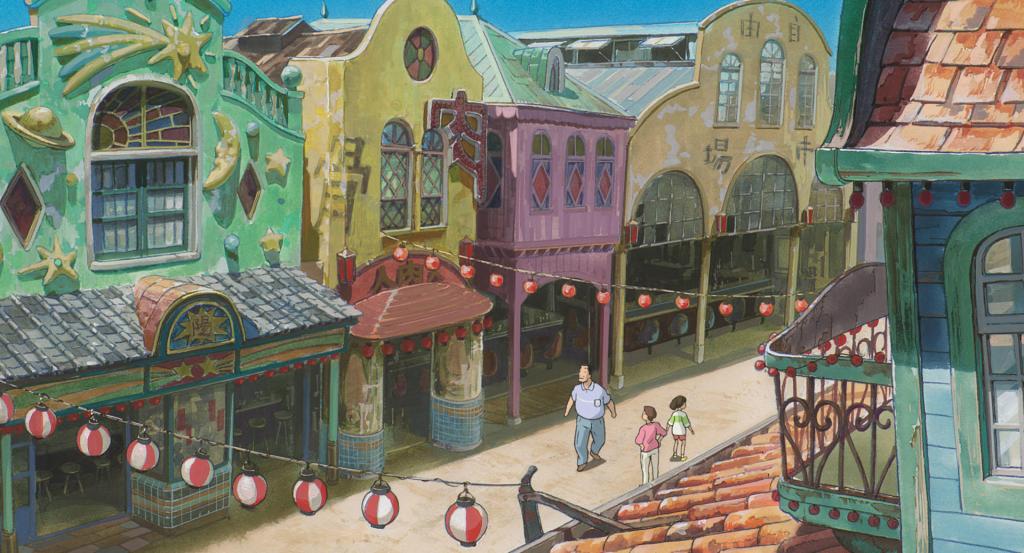
The opening sequence of Spirited Away provides an example of how animation can create curiosity through the gradual control of spatial information. When Chihiro and her parents enter the apparently abandoned town, the film does not immediately explain where they are or how the space functions. In the selected image, the characters appear small within a much larger environment. The street continues beyond the frame, while shop entrances, columns and awnings partially hide the interiors. The image gives the audience many details to examine, but not enough information to fully understand them.
This encourages the audience to search the environment for clues. The buildings and lanterns suggest that the town has a purpose, although no inhabitants are visible and no explanation is provided. As the characters continue moving, new spaces, food stalls and changes in lighting are introduced gradually. Each detail acts like a small piece of feedback, encouraging further attention rather than resolving the uncertainty immediately.
Sound supports this process. Footsteps, wind and echoes suggest areas beyond what the camera currently shows. Instead of simply establishing an unsettling atmosphere, these sounds encourage the audience to listen for information about the space. Curiosity develops through the relationship between what can be seen, what can be heard and what remains inaccessible.
The sequence still contains narrative curiosity because we want to know what will happen to Chihiro and her family. However, my focus here is on spatial and perceptual curiosity: the desire to examine the environment, follow its sensory clues and understand how it works. The sequence shows that animation can create curiosity by controlling the audience’s access to visual and auditory information, rather than relying only on plot.
Conclusion
This week made me reconsider how feelings can be created through different forms of audiovisual expression. Haig’s practice shows how both direct and subtle approaches can support a concept. Meanwhile, Spirited Away demonstrates how a subtle sense of the uncanny can also produce curiosity by making a space feel unfamiliar and unresolved. This suggests that different feelings do not always exist separately; they can overlap and strengthen one another.
Next Steps
I will revisit the four strategies from my presentation and explore how image, sound, movement and pacing can shape audience experience. I also want to find more examples that create multiple feelings at the same time, without limiting my research or future experiments to one concept or a fixed combination of uncanny and curiosity.
AI Acknowledgement
I used ChatGPT to organise my notes and refine the expression; all ideas, analysis and final decisions are my own.
Reference List
Haig I (2024) Instagram Auto Surgery , Fantastic Film Festival Australia website, accessed 6 August 2026.
Haig I (2024) Worm Pornography , Chroma Art Film Festival website, accessed 6 August 2026.
Haig I (2026) ‘Guest lecture on experimental audiovisual practice’, HMsEx studio, RMIT University, Melbourne, 6 August.
Haig I (2026) The Cerebral Organoid , RMIT School of Art website, accessed 6 August 2026.
Miyazaki H (2001) Spirited Away [animated film], Studio Ghibli, Japan.