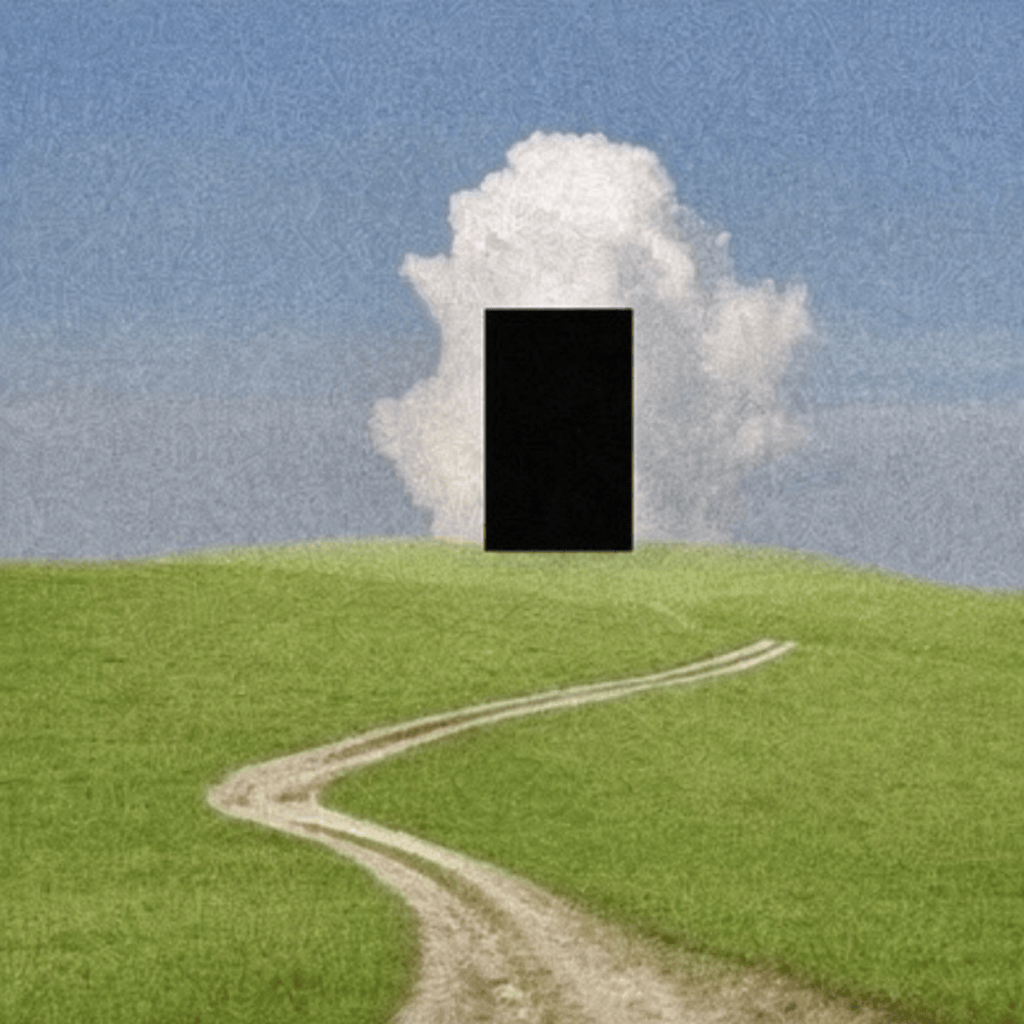
The sky is bright. The grass is almost perfectly green. Nothing in the image looks openly threatening.
But there is a black doorway standing alone in the middle of the field.
It has no wall around it and no visible interior. I cannot tell whether it leads anywhere at all.
The scene looks peaceful and strangely familiar. At the same time, I would not feel safe walking towards it.
That reaction became the starting point for my guiding question:
How is an uncanny experience constructed in art and design?
My first working definition was:
The uncanny is an uneasy audience response that occurs when something recognisable can no longer be interpreted with complete confidence.
Ernst Jentsch’s On the Psychology of the Uncanny helped me name this feeling. The essay was published in 1906; I read the 1997 English translation.
Jentsch connects the uncanny with what he calls intellectual uncertainty. This happens when we cannot confidently decide what we are looking at. Is it living or inanimate? Genuine or artificial? Acting freely or moving mechanically? (Jentsch 1997).
I first began noticing similar patterns while reading a Chinese online horror text commonly known as Zoo Rules. Several English translations circulate online. In this journal, I refer to it as City Zoo: Visitor Guidelines.
My focus here is not mainly on its narrative content. I am interested in how individual sentences, recurring images and conflicting instructions create an uneasy reading experience.

Across this text and the other examples, four recurring design strategies emerged: ways a familiar structure can be made unreliable.
Part 1: How can familiarity be disturbed?
First, a mismatch can be created between form and content.
In City Zoo: Visitor Guidelines, the official tone does not match the instability of the information.

Rule 4 creates a mismatch between form and content: a practical visitor rule calmly warns against the impossible ‘Rabbit Blood’.
I noticed a similar mismatch in a very different medium: an older Chinese psychiatric educational film designed to explain and classify psychiatric symptoms.
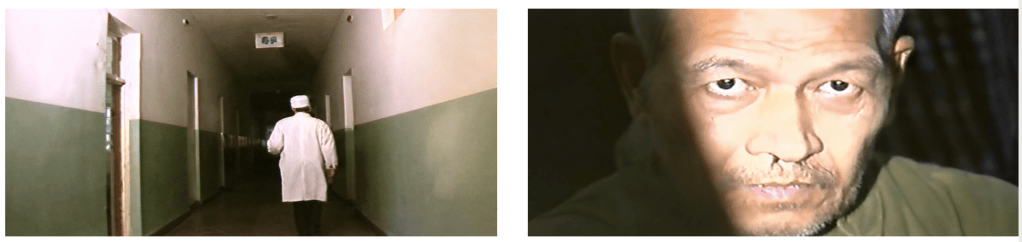
Some images could almost belong to a horror film: a figure in a white coat disappears into a dark corridor, then a distressed face suddenly fills the screen. The narrator remains calm and clinical.
The image suggests danger and loss of control, while the voice presents the subject as something that can be observed, named and classified.
The film also cuts to decorative educational graphics.

The sparkling stars feel closer to children’s television or light entertainment than to psychiatric education. Between unsettling medical images, they pull the film between clinical explanation, horror-like imagery and playful decoration.
A familiar form can become unsettling when it presents content or sensory expression that conflicts with what that form normally leads us to expect.
A familiar function can also be reversed or weakened.
One of the clearest reversals in City Zoo: Visitor Guidelines concerns familiar animal associations.
Animals usually understood as harmless become dangerous, while animals that are normally feared are presented as sources of safety.
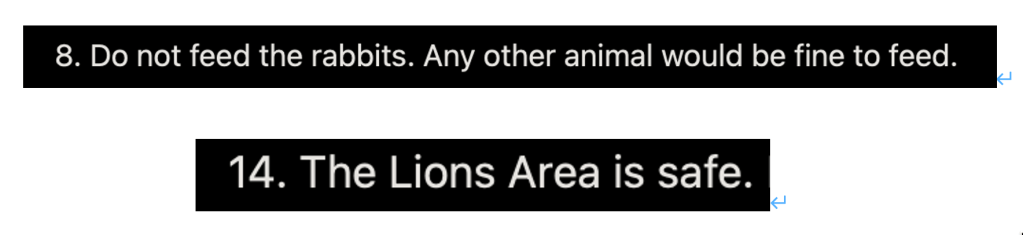
This changes the knowledge readers would normally use to judge danger.
I found a similar reversal in a video designed to imitate an older Chinese television time-calibration broadcast. These broadcasts were originally used to help viewers synchronise the clocks in their homes.

In this version, the broadcast makes time less reliable: seconds continue beyond 59, impossible dates appear, and the weekday becomes question marks.

The electronic beep continues steadily, as if the system believes everything is normal.
The clock still performs the confidence and regularity of accuracy while no longer letting the viewer use time properly.
An unresolved anomaly can become stronger through repetition.
In City Zoo: Visitor Guidelines, the rabbit motif keeps returning.
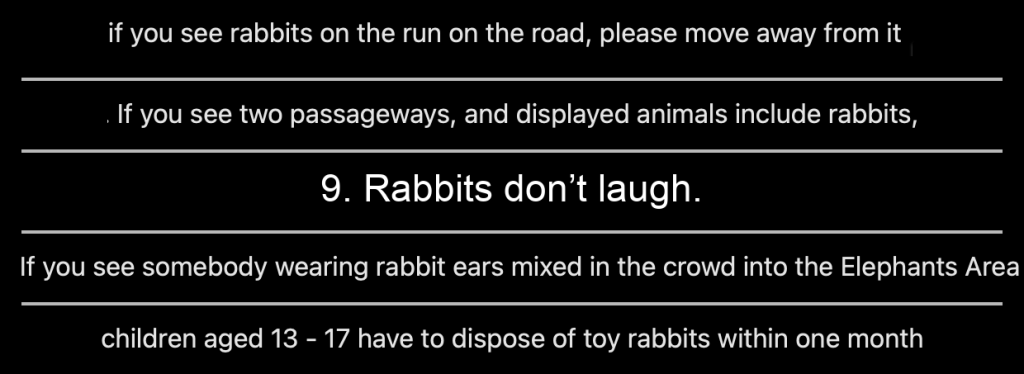
Each return confirms that the rabbit matters without explaining what it means; readers connect it to escape, danger, false information and unstable identity, but each new reference adds only another fragment.
Gregor Schneider’s Die Familie Schneider (2004) produces a comparable effect through spatial duplication. Visitors arrived in pairs, collected keys and entered two neighbouring houses separately. After ten minutes, they came out, exchanged keys and then entered the other house alone. No guide explained how the two experiences were related.
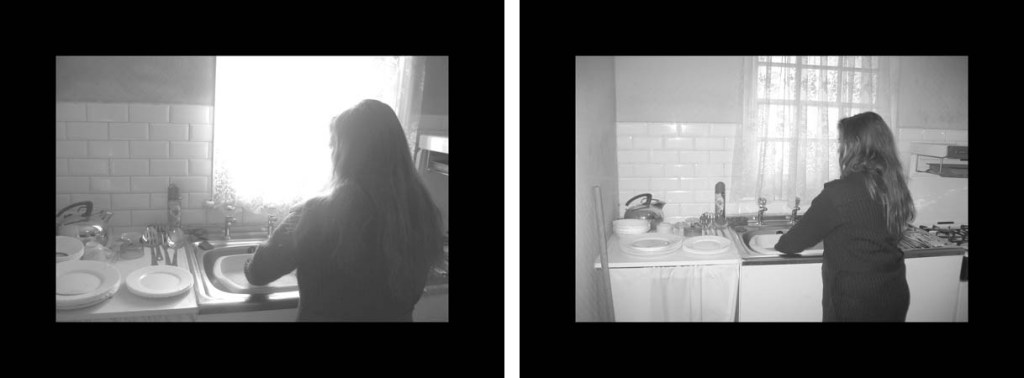
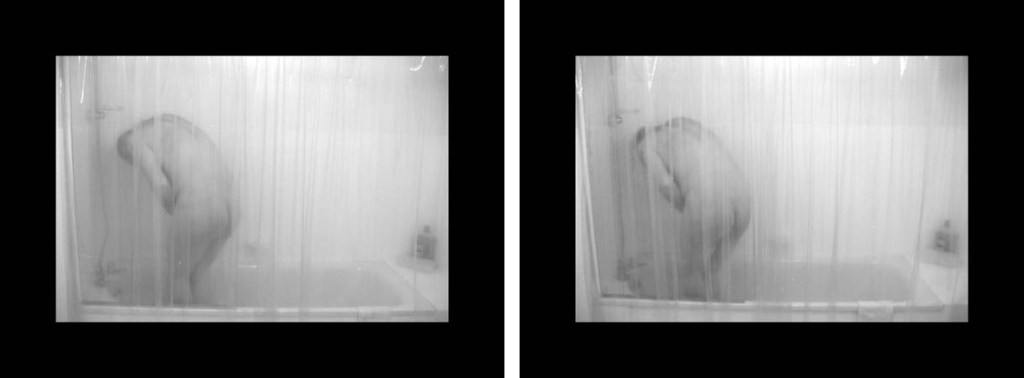
In Die Familie Schneider, the anomaly lies in the visitor’s social position: occupants ignore a stranger entering their private rooms. The second house repeats the same people and routines without explanation, so repetition deepens rather than resolves the uncertainty (Artangel 2004).
Repetition strengthens the disturbance when it repeatedly confirms an anomaly without explaining or resolving it.
Several incompatible interpretations can remain active at the same time.
The different documents in City Zoo: Visitor Guidelines use a similar official tone, but they do not always describe the same reality.
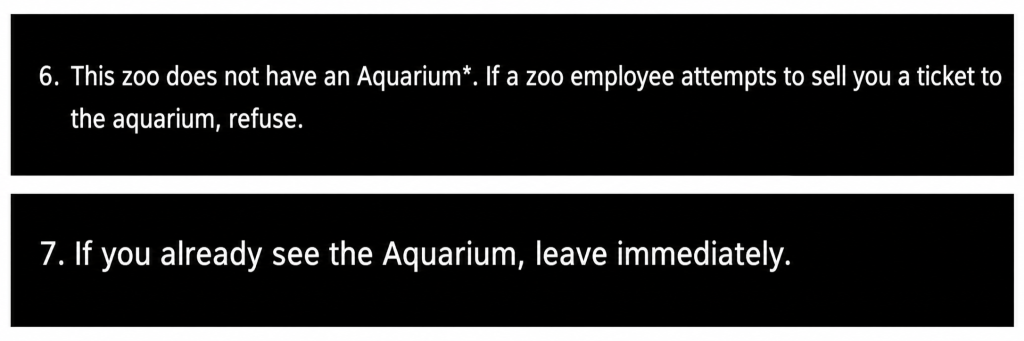
One rule may tell the reader to trust a location, uniform or map; another warns against the same source of information.
Because both appear official, neither is easy to dismiss; following one can make the other impossible to obey.
The Stanley Parable (Galactic Cafe 2013) shows the same conflict in a game.
At an early point, the narrator states that Stanley chose the left door. The player can immediately walk through the right door instead.
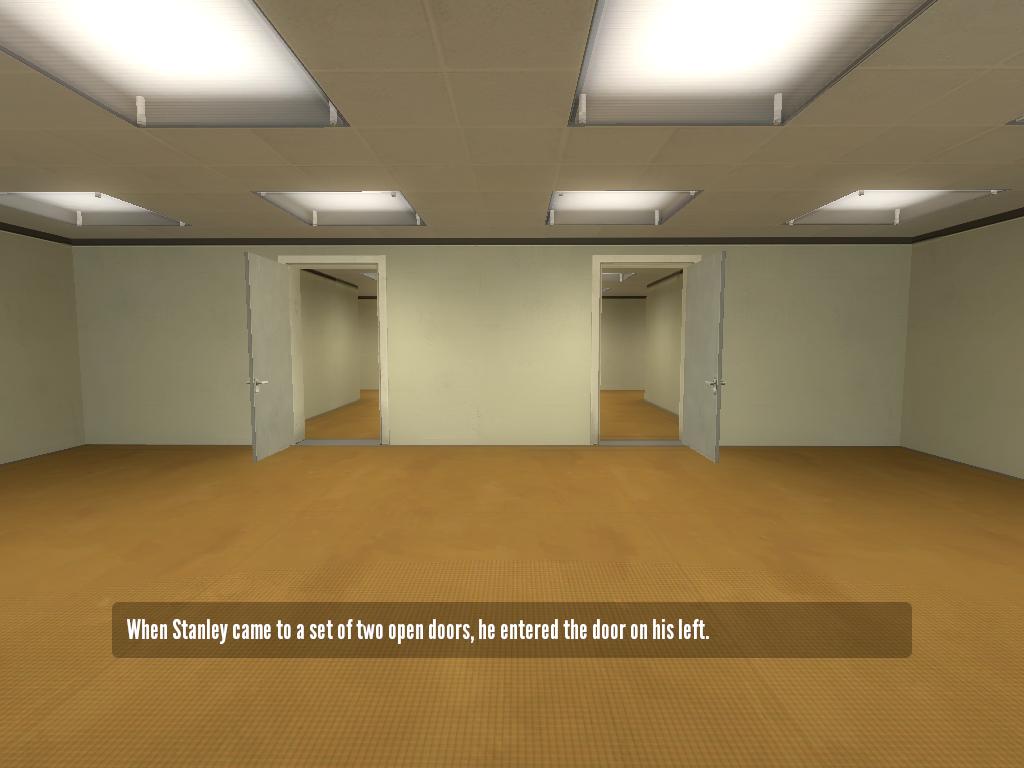
The narrator continues as if the left-door story is true, while the player’s right-door choice creates another. Both versions remain active.
The uncanny continues because no single explanation becomes secure enough to replace the others.
At this point, my first answer was:
An uncanny experience can be constructed by preserving a recognisable framework while changing the relationships that normally make it coherent, useful or trustworthy.
But was that enough?
Not quite.
These four strategies described how familiarity could be disturbed, but they did not fully explain why some disturbances feel uncanny while others simply look unusual.
A comparison between animated characters and low-quality AI-generated short dramas helped me understand the gap.

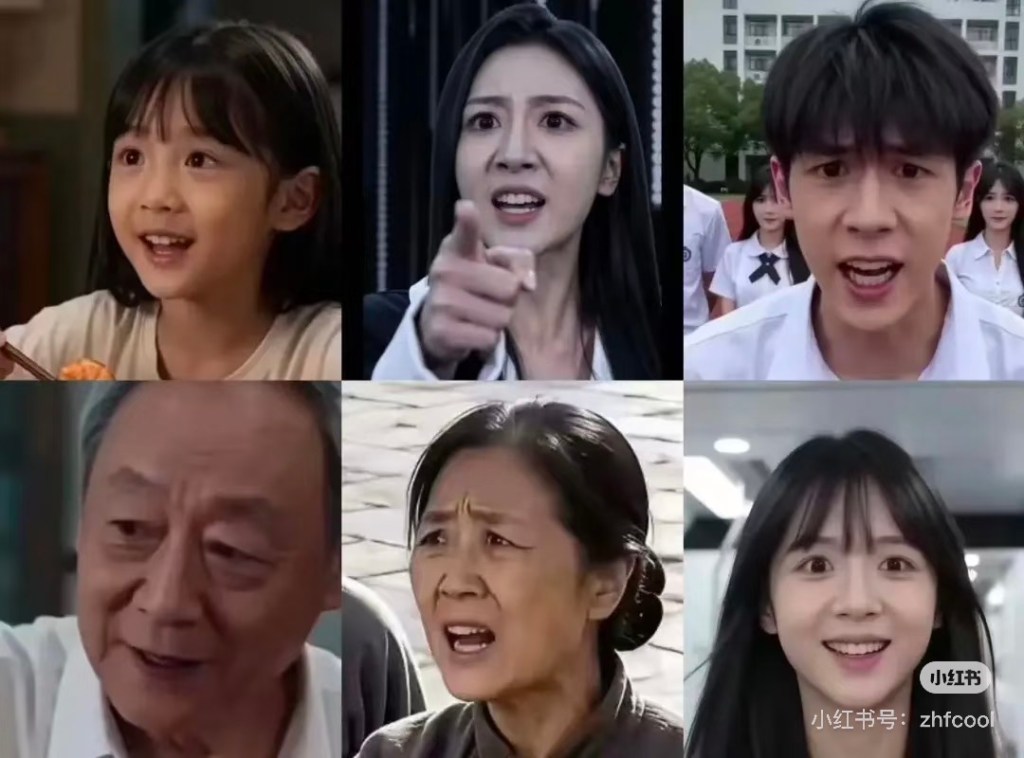
Animated characters often share similar face shapes and expression patterns, but this reads as a consistent style because audiences know they are simplified and artificial.
The photorealistic AI-generated short-drama clips I examined create a different response.
A single character may look convincing, but similarities emerge across several supposedly different characters: facial proportions, skin textures, and movements around the mouth, eyebrows and eyes begin to repeat.
The images still ask me to see separate, realistic people, while the repeated facial system shows through.
Jentsch’s idea of intellectual uncertainty helped me understand this difference. The issue is not repetition alone. The repetition begins to interfere with whether I can continue reading each face as an individual human subject.
This raised a second question:
What kinds of familiar human expectations must these strategies disrupt to produce an uncanny response?
Part 2: What kinds of trust are being disturbed?
Why do faces matter so much?
The first expectation concerns how we recognise another living subject.
Eyes and faces suggest attention, emotion, consciousness and individual identity. When a human face appears where it should not, or when a humanlike figure does not behave as expected, those judgments become unstable.
Tony Oursler’s MMPI (Self-Portrait in Yellow) (1996) is a direct example.
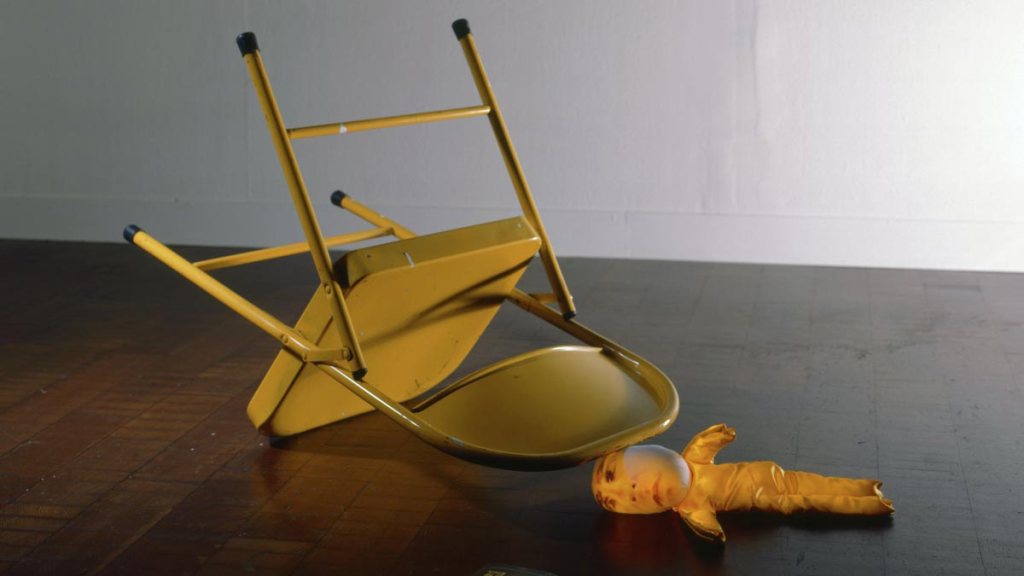
The figure speaks Oursler’s responses to the Minnesota Multiphasic Personality Inventory, a psychological test used to assess mental health. The Milwaukee Art Museum connects the work to Oursler’s interest in how psychological systems define what is considered “normal” (Milwaukee Art Museum 2014).
The cloth body is obviously not alive. The projected eyes and speaking mouth, however, make it difficult to treat the figure as an ordinary object.
A moving hand on the doll might look unusual, but a face suggests that something can see, think and respond—and that an individual identity exists behind the image.
The work therefore makes the boundary between object and subject difficult to maintain.
Repliee Q2 extends this conflict across the whole body.
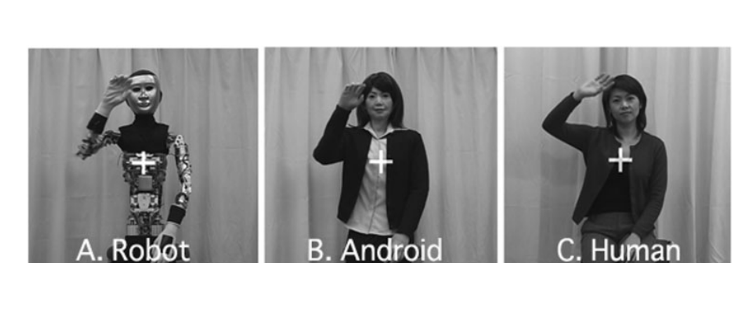
Figure 7 compares the same robot without skin (A), Repliee Q2 in android form (B), and the human model (C).
In a study by Saygin and colleagues, participants watched the human model, Repliee Q2 in its complete android appearance, and the same robot with its humanlike exterior removed. The exposed robot’s mechanical movement suited its appearance. Repliee Q2 created a stronger conflict because its human surface led viewers to expect biological movement (Saygin et al. 2012).
Knowing that Repliee Q2 is a machine does not immediately remove the conflict. Its appearance still activates expectations formed through years of watching human bodies move.
This also explains the AI short-drama example.
Cartoon characters can share facial structures because they do not claim to reproduce the full detail of real human appearance. Their similarity is easy to accept as style.
Photorealistic AI characters are different. Each figure appears detailed enough to be read as a separate person. When several characters reveal the same facial structure or expression patterns, the image begins to shift between two readings: an individual person and the repeated output of an artificial system.
Across Oursler, Repliee Q2 and AI-generated faces, the uncanny strengthens when human signs and artificial systems conflict.
What changes when the unsafe space is a home?
Some places already prepare us for danger. An abandoned building or a dark tunnel may be frightening, but the threat is expected.
The experience can become more uncanny when the disturbance enters a place that should protect us.
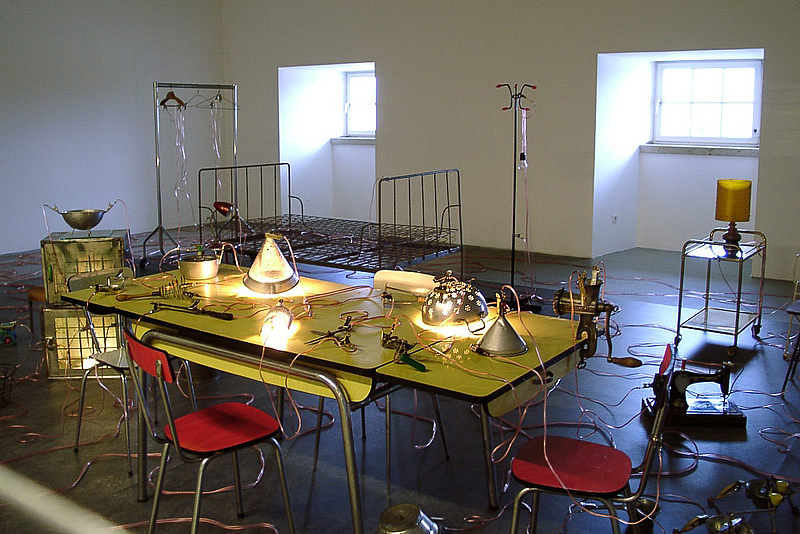
Mona Hatoum’s Homebound (2000) resembles a domestic interior of familiar furniture and household objects that still look usable but no longer feel safe to touch.
Electrical wires connect the objects. Groups of bulbs fade in and out, the sound of the current is amplified, and a wire barrier prevents the audience from entering the space.
The barrier confirms that the danger is not only imaginary. The audience can see the home but cannot enter it.
Anthony Vidler uses the word unhomely to describe a condition in which home remains recognisable while its stability becomes disturbed (Vidler 1992).
This distinction separates an uncanny space from an obviously frightening one.
A dangerous place causes fear because I already expect it to be unsafe. Homebound is different because it preserves the signs of domestic comfort while removing the protection they normally promise.
The place that should protect the body can no longer be trusted.
What if the disturbing element is already familiar?
Jentsch helped me think about uncertainty in the present: I encounter something and cannot decide what it is.
Freud’s The “Uncanny” offers another direction. He connects the uncanny with something once familiar that has been psychologically contained, rejected or repressed, but later returns in a disturbing form.
His examples include childhood beliefs, doubles, apparently animated objects and involuntary repetition (Freud 1955).
Freud’s account changes how I read the psychiatric educational film: calm narration, horror-like imagery and playful graphics appear together.
From a Freudian perspective, the film can be read as staging familiar anxieties about mental illness and loss of control. Its clinical format tries to make these anxieties legible, while its disturbing images allow them to return in an uneasy form.
The threat does not need to be supernatural. The uneasy response can come from recognising an existing social fear inside a familiar educational form. The disturbance is therefore not always produced by something completely new. Sometimes it happens when a familiar fear returns after appearing to have been explained, controlled or kept at a safe distance.
Current Answer
Returning to the Dreamcore image at the beginning, I can now explain my response more clearly.
The blue sky and green field create a familiar, apparently safe environment, but the black doorway has no wall, visible interior or clear purpose.
The image contains several of the strategies I identified. A recognisable landscape includes something that does not fit its surroundings. The field still appears peaceful, but it no longer feels completely safe.
The doorway also leaves several interpretations open. It could be an entrance, an empty shape, a digital error or a passage into somewhere outside the image.
The landscape has an emotional familiarity as well. Its simplified colours and open space resemble an idealised memory, a game environment or an image of childhood freedom.
My current answer to the guiding question is:
An uncanny experience can be constructed by preserving enough familiar information for an audience to recognise and trust a body, object, space or system, while introducing a disruption that makes this trust unstable.
The four design strategies help create that disruption.
The response becomes stronger when the disruption affects an expectation that matters to the viewer: whether something is human, whether a face belongs to an individual, whether a space is safe, whether an authority is reliable, or whether a familiar fear has really been contained.
The uncanny is therefore not simply the presence of something strange.
Something remains familiar enough to be recognised, but no longer stable enough to provide security.
Reflection
This research has changed how I want to approach the uncanny in future projects.
My background is mainly in animation and game art, so this semester I want to give particular attention to visual relationships, especially colour, light and their interaction.
I am less interested in making something openly terrifying or surreal. I would rather create an image, animation or environment that feels calm, harmonious or comforting before a small disturbance makes the audience question it.
The uncanny is rarely produced by one element alone.
A colour is not automatically uncanny. Neither is darkness, an empty room or a distorted sound. Their effect depends on how they interact with the rest of the work and with what the audience expects.
A calm visual environment could be paired with a sound that feels emotionally inappropriate. A serious institutional space could use unexpectedly playful colours. A familiar action could occur before the audience causes it. An apparently safe object could respond as though it were aware of the viewer.
These combinations interest me more than conventional horror imagery. The disturbance can remain small while changing the meaning of the whole experience.
In future work, I want to bring lighting, colour, movement and spatial layout together with sound and other sensory elements. Rather than choosing a “creepy” colour palette first, I would begin by asking what the audience expects from the scene and which relationship I want to make unreliable.
I also want to continue studying psychological and artistic examples, particularly those involving human identity, safe spaces and familiar memories.
The aim would not be to make the experience as frightening as possible, but to preserve calmness and familiarity long enough for a small contradiction to disturb them.
AI use statement
I used generative AI as a support tool to organise my examples and provide final language editing. All ideas, arguments and case analyses in this journal are my own.
References
混沌馄饨 (2021) ‘Zoo Rules English Translation, Version 1.02’, Zhihu, viewed 3 August 2026, https://zhuanlan.zhihu.com/p/442376743. Original work credited in the post to phKeaLx.
北京第二医学院电教科和北京安定医院 (1983) 《精神疾病常见症状》 [教育片], 12月.
我的职业不是梦 (2023) ‘精神疾病常见症状 上集’ , Bilibili, December, viewed 3 August 2026, https://b23.tv/iYkf9JB.
寒夜治也 (2024) ‘请校准时钟(二)’ , Bilibili, January, viewed 3 August 2026, https://b23.tv/V9sIBHb.
Artangel (2004) Die Familie Schneider, Gregor Schneider [installation], London, 1 October–23 December, viewed 3 August 2026, https://www.artangel.org.uk/project/die-familie-schneider/.
Bem, G. (2013) ‘Educating Determinism in The Stanley Parable’, The Expandable Gamer, 9 November, viewed 3 August 2026, https://existencegaming.wordpress.com/2013/11/09/educating-determinism-in-the-stanley-parable/.
Anime & Manga Stack Exchange (2015) ‘Why do anime and manga use the same faces?’, viewed 3 August 2026,https://anime.stackexchange.com/questions/22624/why-do-anime-and-manga-use-the-same-faces.
Galactic Cafe (2013) The Stanley Parable [computer game], Galactic Cafe.
Freud S (1955) ‘The uncanny’, in Strachey J (ed. and trans.) The standard edition of the complete psychological works of Sigmund Freud, volume 17, Hogarth Press, London, pp. 217–256. Original work published 1919.
Hatoum, M. (2000) Homebound [mixed-media installation].
Universes in Universe (2002) ‘Homebound, installation by Mona Hatoum at Documenta 11’, viewed 3 August 2026,https://universes.art/en/specials/mona-hatoum/documenta-2002/5-homebound. Installation photograph: Haupt & Binder.
Jentsch E (1997) ‘On the psychology of the uncanny (1906)’, trans. Sellars R, Angelaki, 2(1):7–16, doi:10.1080/09697259708571910.
Fallone, E. (2014) ‘From the Collection: MMPI (Self-Portrait in Yellow) by Tony Oursler’, Milwaukee Art Museum Blog, 27 May, viewed 3 August 2026, https://blog.mam.org/2014/05/27/discovering-the-guy-with-the-chair-on-his-head/.
Oursler T (1996) MMPI (Self-Portrait in Yellow) , Milwaukee Art Museum, Milwaukee.
Saygin, A.P., Chaminade, T., Ishiguro, H., Driver, J. and Frith, C. (2012) ‘The thing that should not be: predictive coding and the uncanny valley in perceiving human and humanoid robot actions’, Social Cognitive and Affective Neuroscience, 7(4), pp. 413–422, viewed 3 August 2026, https://pmc.ncbi.nlm.nih.gov/articles/PMC3324571/.
Guizzo, E. (2010) ‘Robots for Real: The Amazing Androids of Hiroshi Ishiguro’ , IEEE Spectrum, viewed 3 August 2026, https://spectrum.ieee.org/the-amazing-androids-of-hiroshi-ishiguro. (Video includes Repliee Q2.)
Tate (n.d.) ‘Mona Hatoum: room guide’, Tate website, accessed 2 August 2026.
Vidler A (1992) The architectural uncanny: essays in the modern unhomely, MIT Press, Cambridge, Massachusetts.